Monday to Saturday - 8:00 -18:00 (CET/CEST)
Okuma VTM Series Repair & Support
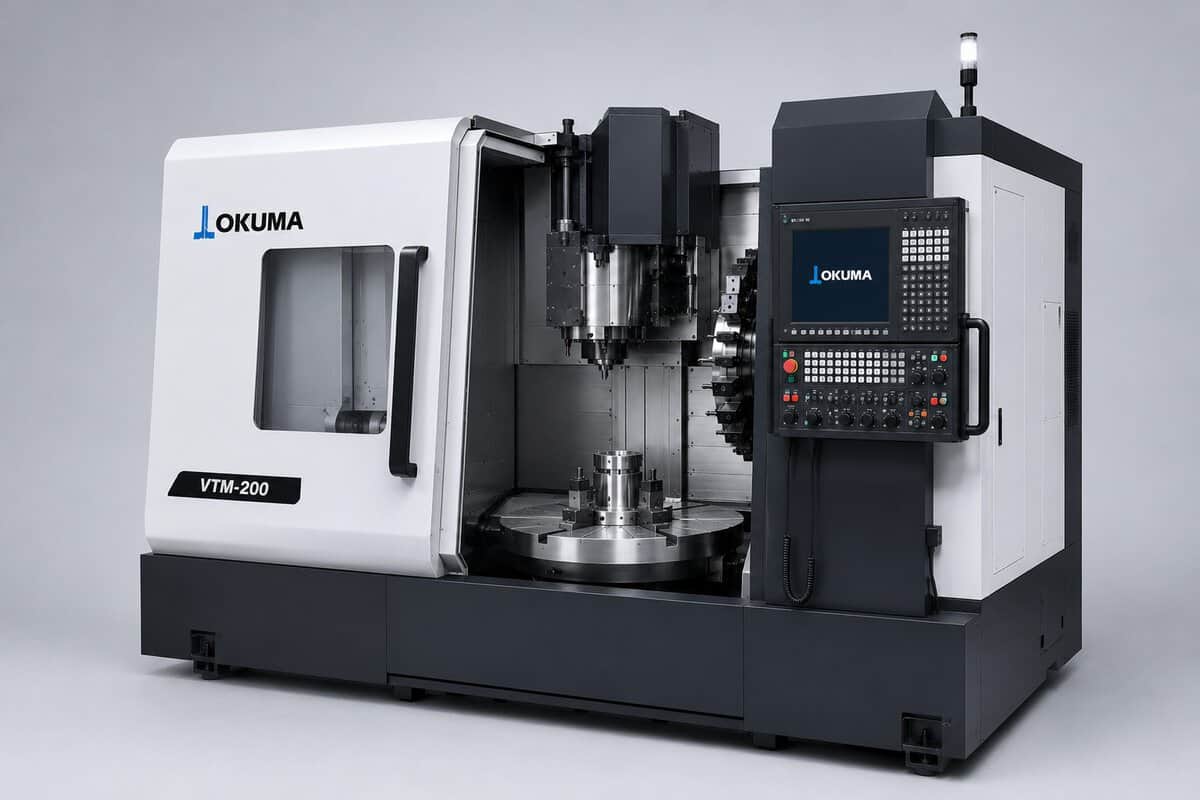
Diagnostics and repair for Okuma’s vertical turning centers — the VTM-65, VTM-100 and VTM-200 — built to combine vertical lathe turning with full machining-center milling on one platform.
What Is the Okuma VTM Series?
Every other Okuma lathe on this site — the LB, GENOS L, LU and TWIN STAR LT Series — holds the workpiece horizontally. The VTM Series does the opposite: it’s a vertical turning center, with the chuck mounted flat and the part spinning around a vertical axis, more like a vertical machining center than a conventional lathe. That orientation is what makes the VTM Series genuinely different rather than just another size class — gravity works with the machine rather than against it when handling large, heavy, awkward workpieces like valve bodies and flanges.
What sets the VTM apart from a simple vertical lathe is its 50-taper, 36-tool (optionally 60-tool) magazine, which lets a single machine complete both the turning and the heavy milling operations a part needs — drilling, tapping, contour milling — without moving the workpiece to a second machine. Okuma builds the VTM on box-way construction with wide, angular slideways for rigidity, uses a vertical-axis counterbalance to keep feed smooth and stable against gravity at every speed, and fixes the headstock to the base to minimize the effect of thermal changes and vibration on accuracy. For shops that would otherwise need a separate vertical lathe and a separate machining center to finish a valve body or similar part, consolidating both processes onto one VTM machine also means one less handling step and one less source of setup error.
One detail worth knowing before you call anyone for VTM repair: Okuma has historically offered the VTM Series with either an OSP control or a FANUC control, depending on the customer’s original order — unusual for an Okuma machine, most of which ship with OSP only. Our expertise is specifically with OSP-equipped VTM machines; if yours has a FANUC control, many mechanical components (spindle, counterbalance, tool magazine) are still within our scope, but control-board repair would need to go through a FANUC-focused specialist. This split isn’t unique to one model in the range either — VTM-65, VTM-100 and VTM-200 have all been sold with both control options over the years, so the control type has to be confirmed on a machine-by-machine basis rather than assumed from the model number.
VTM Series Models & Specifications
The three current VTM models scale from mid-size valve-body work up to very large parts, sharing the same core architecture at increasing capacity.
VTM-65
- Max. turning diameter: 650-750 mm
- Max. turning length: 635 mm
- Spindle speed: up to 1,250 min⁻¹ (infinitely variable, OSP)
- Tool magazine: 36 (60 optional), No. 50 taper
- Motor: 15/11 kW (OSP) or 7.5/5.5 kW (FANUC)
VTM-100
- Max. turning diameter: 1,000 mm
- Max. turning length: 840 mm
- Spindle speed: up to 1,000 min⁻¹ (OSP, gear shift)
- Tool magazine: 36 (60 optional), No. 50 taper
- Motor: 45/37 kW (OSP) or 30/22 kW (FANUC)
VTM-200
- Max. turning diameter: 2,000 mm
- Max. turning length: 1,200 mm
- Spindle speed: up to 200 min⁻¹ (flat-face large diameter)
- Tool magazine: 36 (60 optional), No. 50 taper
- Motor: 30/22 kW (40/30 kW short-duty)
Shared Features Across the Range
- Box-way construction with angular slideways
- Vertical-axis counterbalance for smooth feed
- Fixed headstock for thermal and vibration stability
- Standard spindle orientation function
Which Control Does the VTM Series Use?
On OSP-equipped machines, VTM Series units generally run OSP-P300 or Okuma’s newer control generations on more recent units, with a multi-touch panel for intuitive graphical operation — rotating and zooming 3D tool-path models directly on the control screen. Because the VTM platform has been in production for many years and is sold with a choice of control, the specific OSP version fitted varies more between individual machines than on Okuma’s single-control-only lathe lines.
Before ordering any replacement control board, we always confirm which control — and which OSP generation, if applicable — is actually fitted, either from the nameplate on the control cabinet or a photo of the startup screen. Given the FANUC option mentioned above, this confirmation step matters more on the VTM Series than on almost any other Okuma model we support, and skipping it is the single most common way a repair ends up taking longer than it should on this platform.
Common VTM Series Faults We Repair
The VTM’s vertical orientation and combined turning/milling capability create a fault profile that looks quite different from a horizontal lathe.
Vertical-axis counterbalance faults
Because the VTM’s vertical axis works against gravity rather than alongside it, a failing counterbalance system shows up as jerky or inconsistent feed, particularly at low speed or during direction changes — something a horizontal-lathe technician may not immediately recognize as a counterbalance issue rather than a drive fault. We check the counterbalance system specifically before assuming the axis drive itself is at fault, since replacing a perfectly good drive board doesn’t fix a mechanical or hydraulic counterbalance problem, and the reverse is equally true.
Spindle orientation faults
The spindle orientation function — standard equipment on VTM machines and used for precise tool-change positioning — can fail independently of the main spindle drive. Symptoms include tool changes stopping mid-cycle or orientation alarms that don’t correspond to any other spindle issue, usually traced to the orientation sensor or its associated control logic rather than the spindle motor itself.
Tool magazine and ATC faults
With a 36- or 60-position, No. 50 taper tool magazine handling both turning and milling tools, indexing errors, gripper faults and tool-change timeouts are common on higher-hour machines — particularly where heavier milling tools are cycled frequently. These are almost always mechanical or sensor issues in the ATC itself rather than a control fault.
Axis servo alarms on box-way slides
Overload or position-deviation alarms on the box-way X/Z slides are usually a drive or encoder issue rather than genuine mechanical wear, given how heavily over-built the VTM’s slideways are for rigidity. We bench-test the drive before recommending any mechanical slideway work.
Display and operator panel faults
Multi-touch panel and display faults follow the same repair pattern as other OSP-equipped Okuma machines, with digitizer issues more common on newer touch-panel machines than backlight failures.
On every VTM repair, we start by confirming the control type fitted, then isolate the failing component — counterbalance, spindle orientation, ATC or axis drive — through bench testing rather than guesswork. See our fault analysis and testing & diagnostics services for more on our approach.
Components We Repair on the VTM Series
Given the VTM’s vertical, combined turning-and-milling design, these are the parts we’re asked to repair most often:
Spindles
Vertical spindle drive, bearing and orientation function repair.
Control Boards
OSP control board repair for OSP-equipped VTM machines.
Servo & Spindle Drives
Vertical axis and spindle drive electronics repair.
Axis Drives & Counterbalance
Box-way slide drives and vertical-axis counterbalance repair.
Tool Magazine & ATC
36/60-position tool magazine indexing and gripper repair.
Operator Panels & Displays
Multi-touch panel and display repair for OSP control screens.
VTM Series Repair Services
The following services apply directly to VTM Series machines, whatever the fault:
CNC Control Repair
Board-level repair for OSP-equipped VTM control units.
Drive Units Repair
Component-level repair of vertical-axis and spindle drives.
Testing & Diagnostics
Practical fault diagnosis before any repair work begins.
Spindle Repair & Maintenance
Vertical spindle and orientation function service.
Emergency & Express Repair
Priority turnaround with loaner units to minimize downtime.
Retrofit & Modernization
Upgrade path for older VTM machines running legacy controls.
Industries That Rely on the VTM Series
The VTM’s ability to turn and mill large, heavy parts in one setup makes it a natural fit for:
Where We Support VTM Series Machines
CNC Elektronik is based in Germany, where most of our VTM Series repair work is carried out — either on the bench once boards or drives are shipped to us, or on-site given how large and difficult to move these machines typically are.
We’ve also supported VTM Series repair work in Brazil, where valve-body and heavy industrial component production for the energy sector makes large vertical turning centers a common fixture. The process doesn’t change with distance: confirm the control type fitted, isolate the failing component — counterbalance, spindle orientation, ATC or drive — and repair or replace it, then verify the machine under real load before it returns to production. Given how much floor space and how much of a production line a machine of this size occupies, clients typically want the control-type confirmation done quickly so the right parts can be sourced on the first attempt rather than after a failed guess.
See our Countries We Serve page for our full regional coverage across Europe, the Americas, and parts of Asia and the Middle East.
Explore More Resources
The VTM Series is one part of a much wider Okuma ecosystem. Here’s where to go next:
All Okuma Models
Browse every Okuma machine series and model we repair.
OSP Controls
Every OSP control generation we diagnose and repair.
Automation & Robotics
Support for pallet changers and robot cells fitted to VTM machines.
Components & Parts
Every part type we repair, across the full Okuma range.
Countries We Serve
Where our repair and support coverage extends to.
Spare Parts
New and used Okuma electronics spare parts, tested before sale.
Frequently Asked Questions
Check the control cabinet nameplate or the startup screen — OSP and FANUC controls look and operate quite differently. Send us a photo and we’ll confirm which you have and whether we can support it directly.
The VTM holds the part vertically rather than horizontally, and combines full turning and milling capability through a 36/60-position tool magazine — closer to a machining center with turning capability than a traditional lathe.
Not necessarily. On a vertical machine, this is a classic symptom of a counterbalance system issue rather than the axis drive itself — we check the counterbalance first before condemning the drive.
Yes. The 36/60-position tool magazine and ATC are a core part of what we support on VTM machines, alongside the spindle, control and axis drive electronics.
In most cases, yes. Given the size and cost of a VTM machine, component-level repair of a control board, drive or tool magazine part is a small fraction of the cost of a replacement, and the heavy-duty box-way construction means these machines hold accuracy for decades.
Have a VTM Series Issue?
Send us your model number, control type and a description of the fault — we’ll get back to you with a practical assessment.