Monday to Saturday - 8:00 -18:00 (CET/CEST)
Okuma Aluminum Wheel Application Lathe Repair
Diagnostics and repair for Okuma’s V Series vertical lathes — V40R, V100R, V760EX and V920EX, including the twin-spindle 2SP-V variants built for high-volume aluminum wheel production.
What Are Okuma’s Aluminum Wheel Application Lathes?
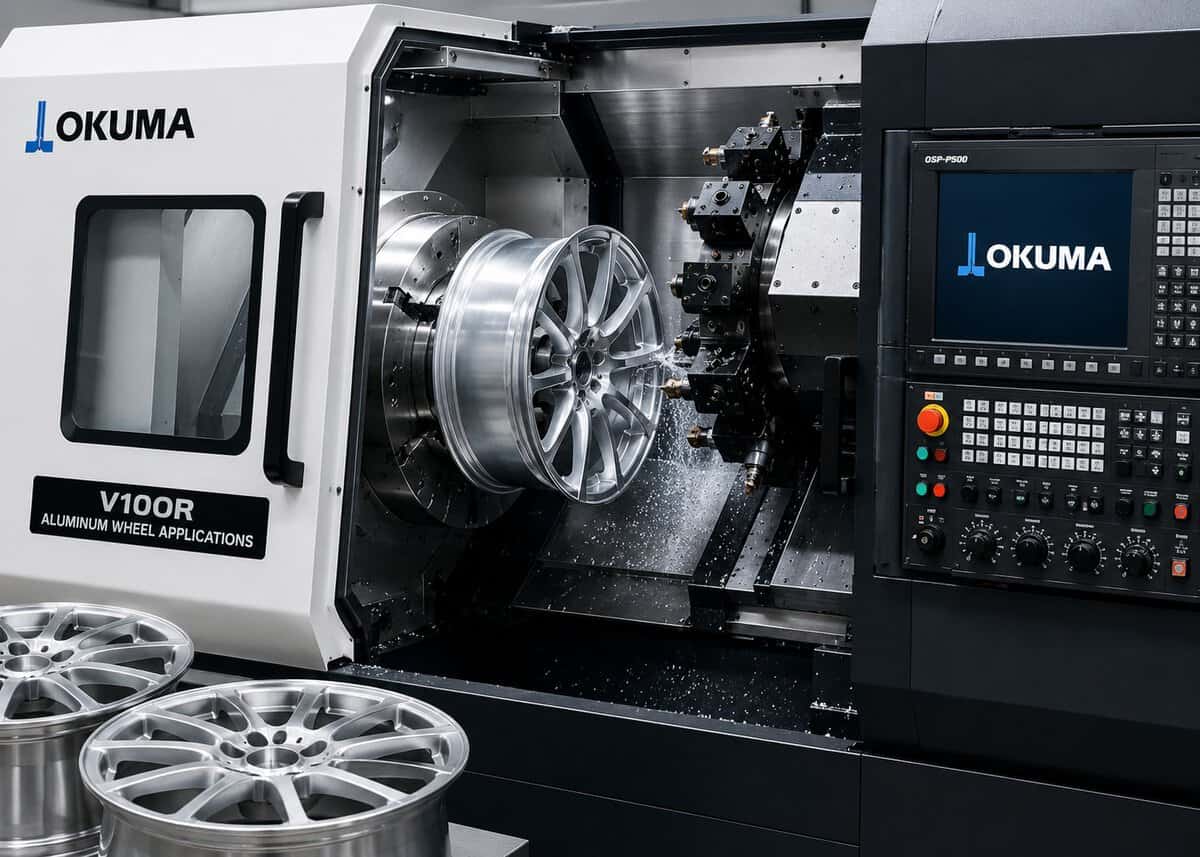
Aluminum wheels are, mechanically speaking, an awkward part to machine: thin-walled, large in diameter relative to their thickness, and often slightly unbalanced before the final cut. Okuma’s V Series vertical lathes — V40R, V100R, V760EX and V920EX — are built specifically around that problem. Rather than holding the workpiece horizontally the way a conventional lathe does, the V Series chucks the part on a vertical, rotary-table-style spindle, so gravity pulls straight down through the part rather than sideways against it. That single change in orientation is what lets these machines hold thin, odd-shaped, unbalanced wheel blanks steady enough for accurate, distortion-free cutting.
The V Series is built on a box-type base and a rigid rectangular column, kept as close to the tool as the design allows to minimize deflection under heavy cuts, and the headstock uses a flange-mounted construction specifically to reduce the effects of thermal drift and vibration over a long production run. For high-volume wheel manufacturing, Okuma also offers twin-spindle 2SP-V760EX and 2SP-V920EX configurations — essentially two separate vertical lathes, one standard and one mirror-image, sharing a single OSP control. This doubles output from roughly the same floor space a single machine would occupy, while keeping the two sides mechanically independent enough that vibration on one spindle doesn’t affect machining quality on the other.
One detail that matters specifically for wheel machining: Okuma builds an enhanced oil-mist filtration system into this line, using an electrostatic trapping method that captures oil mist at up to twice the concentration of the previous generation, without needing filter replacement. Given how much fine aluminum swarf and coolant mist a wheel-machining cell generates over a shift, this filtration system is a genuine production-uptime feature, not just an environmental nicety — and it’s one of the components we’re asked to service on these machines. The system also uses a brushless DC motor for the filtration fan itself, chosen for its energy efficiency, low noise and long service life compared with older brushed-motor designs.
Aluminum Wheel Application Models & Specifications
The V Series spans four single-spindle sizes, plus twin-spindle 2SP variants of the two larger models.
V40R
- Max. turning diameter: 400 mm
- Max. turning length: 450 mm
- Spindle speed: up to 2,500 min⁻¹
- Turret capacity: 12 tools
- Motor: 22/18.5 kW
V100R
- Max. turning diameter: 1,000 mm
- Max. turning length: 890 mm
- Spindle speed: up to 1,250 min⁻¹
- Turret capacity: 12 tools
- Motor: 45/37 kW
V760EX (and 2SP-V760EX)
- Max. turning diameter: 760 mm
- Max. turning length: 770 mm
- Spindle speed: up to 2,200 min⁻¹
- Motor: 30/22 kW · M (milling tools on revolver)
V920EX (and 2SP-V920EX)
- Max. turning diameter: 920 mm
- Max. turning length: 860 mm
- Spindle speed: up to 1,250 min⁻¹
- Motor: 30/22 kW · M + ATC (automatic tool changer)
The V920EX is the only model in the range with a full automatic tool changer, making it best suited to wheel designs needing multiple milling or drilling operations alongside turning. The 2SP-prefixed variants of both the V760EX and V920EX add a second, mirror-image spindle for double throughput under one control.
Which OSP Control Does This Line Use?
Single-spindle V Series machines run a standard OSP control appropriate to their production year, typically OSP-P300 on more recent units. Twin-spindle 2SP-V machines are a special case worth understanding: both spindles are operated from a single OSP control, which means the control has to manage two independent sets of axes, drives and part programs simultaneously rather than just one.
This matters for repair in a practical way: a control-level fault on a 2SP-V machine can sometimes affect both spindles’ scheduling even when only one spindle’s drive hardware is actually broken, which is why we always check both sides of a twin-spindle machine’s diagnostics before concluding a fault is isolated to just one side. A shop that assumes the whole machine is down because one spindle threw an alarm can end up waiting longer for a repair than necessary if the other spindle could actually keep running in the meantime.
Common Faults We Repair on Aluminum Wheel Application Lathes
Wheel machining puts a distinctive set of demands on these machines — high-volume aluminum cutting, continuous coolant/mist exposure, and (on 2SP models) two independent spindles sharing one control.
Spindle drive faults
Continuous high-volume aluminum turning puts steady thermal and electrical load on the vertical spindle drive. RPM instability, overheat trips and unusual noise are most often traced to the drive electronics rather than the spindle bearings themselves — we test the drive under simulated load on the bench before recommending any mechanical spindle work.
Workholding and unbalance-related vibration faults
Because wheel blanks are inherently thin and sometimes slightly unbalanced before final machining, vibration-related alarms and inconsistent surface finish are common complaints. These are usually a chuck, clamping-force sensor, or drive-tuning issue rather than a fundamental problem with the machine’s rigidity — the vertical orientation is specifically designed to handle this workpiece type well, so a persistent vibration issue usually points to a specific component fault.
Twin-spindle (2SP) shared-control faults
On 2SP-V760EX and 2SP-V920EX machines, faults where one spindle’s issue appears to affect the other side’s scheduling or cycle timing usually trace back to the shared OSP control’s task management rather than a true mechanical interaction between the two independent spindles. We diagnose each spindle’s drive and axis hardware separately before looking at the shared control logic.
Oil-mist filtration system faults
The electrostatic oil-mist filtration system fitted to this line is a genuine production-uptime component on high-volume wheel lines — reduced extraction performance shows up as mist buildup around the work area well before it becomes an obvious mechanical alarm. We check filtration performance as part of any broader diagnosis on machines that have been running continuous aluminum production for extended periods.
Display and operator panel faults
Standard OSP panel and display faults follow the same repair pattern as other Okuma lathes, whatever the specific control generation fitted.
We isolate the actual failing component through bench testing and OSP alarm history before repairing or replacing anything, rather than assuming a fault based on symptoms alone. See our fault analysis and testing & diagnostics services for more on our approach.
Components We Repair on Aluminum Wheel Application Lathes
Given the high-volume, continuous-production nature of wheel machining, these are the parts we’re asked to repair most often:
Spindles
Vertical spindle drive diagnosis for single and twin-spindle machines.
Control Boards
OSP board repair, including shared-control logic on 2SP machines.
Servo & Spindle Drives
Drive electronics for continuous high-volume aluminum turning.
Axis Drives & Ball Screws
X/Z feed system repair for the box-way column construction.
Turrets & ATC
12-station turret and automatic tool changer repair (V920EX).
Coolant & Mist Filtration
Electrostatic oil-mist filtration system service and repair.
Repair Services for Aluminum Wheel Application Lathes
The following services apply directly to this line, whatever the fault:
CNC Control Repair
Board-level repair, including twin-spindle shared-control units.
Drive Units Repair
Component-level repair of spindle and axis drive electronics.
Testing & Diagnostics
Practical fault diagnosis before any repair work begins.
Spindle Repair & Maintenance
Service for continuous-duty vertical spindles.
Emergency & Express Repair
Priority turnaround with loaner units to minimize downtime.
Retrofit & Modernization
Upgrade path for older V Series machines on legacy controls.
Industries That Rely on Aluminum Wheel Application Lathes
While built around wheel production, the V Series’ vertical orientation suits any thin, odd-shaped, or large-diameter part:
Where We Support Aluminum Wheel Application Lathes
CNC Elektronik is based in Germany, home to a significant share of Europe’s automotive wheel supply chain, so V Series repair work is a routine part of what we do rather than an occasional job.
We’ve also supported this line further afield, including work in Brazil, where aluminum wheel manufacturing for both domestic and export automotive markets makes vertical lathes like these a common fixture on the shop floor. The process stays the same regardless of distance: confirm which spindle and drive components are actually at fault, repair or replace them, and verify the machine under real production load — including checking filtration performance on continuous-duty lines — before it goes back into service. For a wheel-production cell running near-continuous shifts, even a short repair delay can mean a meaningful gap in output, which is why we prioritize a clear, fast diagnosis on these machines.
See our Countries We Serve page for our full regional coverage across Europe, the Americas, and parts of Asia and the Middle East.
Explore More Resources
These wheel-application lathes are one part of a much wider Okuma ecosystem. Here’s where to go next:
All Okuma Models
Browse every Okuma machine series and model we repair.
OSP Controls
Every OSP control generation we diagnose and repair.
Automation & Robotics
Support for loading systems fitted to high-volume wheel lines.
Components & Parts
Every part type we repair, across the full Okuma range.
Countries We Serve
Where our repair and support coverage extends to.
Spare Parts
New and used Okuma electronics spare parts, tested before sale.
Frequently Asked Questions
The nameplate will show either the base model (e.g. V760EX) or the 2SP-prefixed version (2SP-V760EX). Physically, a 2SP machine has two separate chucking positions sharing one control cabinet. Send us a photo if you’re unsure.
A thin, large-diameter wheel blank held horizontally can sag or distort under its own weight during machining. Holding it vertically lets gravity work straight through the part instead of sideways against it, which is exactly what makes accurate, distortion-free cutting possible.
Yes. Given how central mist management is to continuous aluminum production, we treat the filtration system as a standard part of what we support on this line, not an afterthought.
Not necessarily, since the two spindles are mechanically independent — but because both share one OSP control, a control-level fault can sometimes affect scheduling on both sides even if only one spindle’s hardware is actually broken. We check both sides before concluding a fault is isolated.
In most cases, yes. Component-level repair of a control board, drive or filtration component is typically a small fraction of the cost of a replacement machine, and the box-way, flange-headstock construction is built for a long service life.
Have an Aluminum Wheel Lathe Issue?
Send us your model number, control type and a description of the fault — we’ll get back to you with a practical assessment.