Monday to Saturday - 8:00 -18:00 (CET/CEST)
Okuma LAW Series Wheel Lathe Repair & Support
Diagnostics and repair for Okuma’s dedicated wheel-machining lathes — the LAW-2S, LAW-V24 and LAW-F II — purpose-built for aluminum wheel finishing, not adapted from a general-purpose lathe.
What Is the Okuma LAW Series?
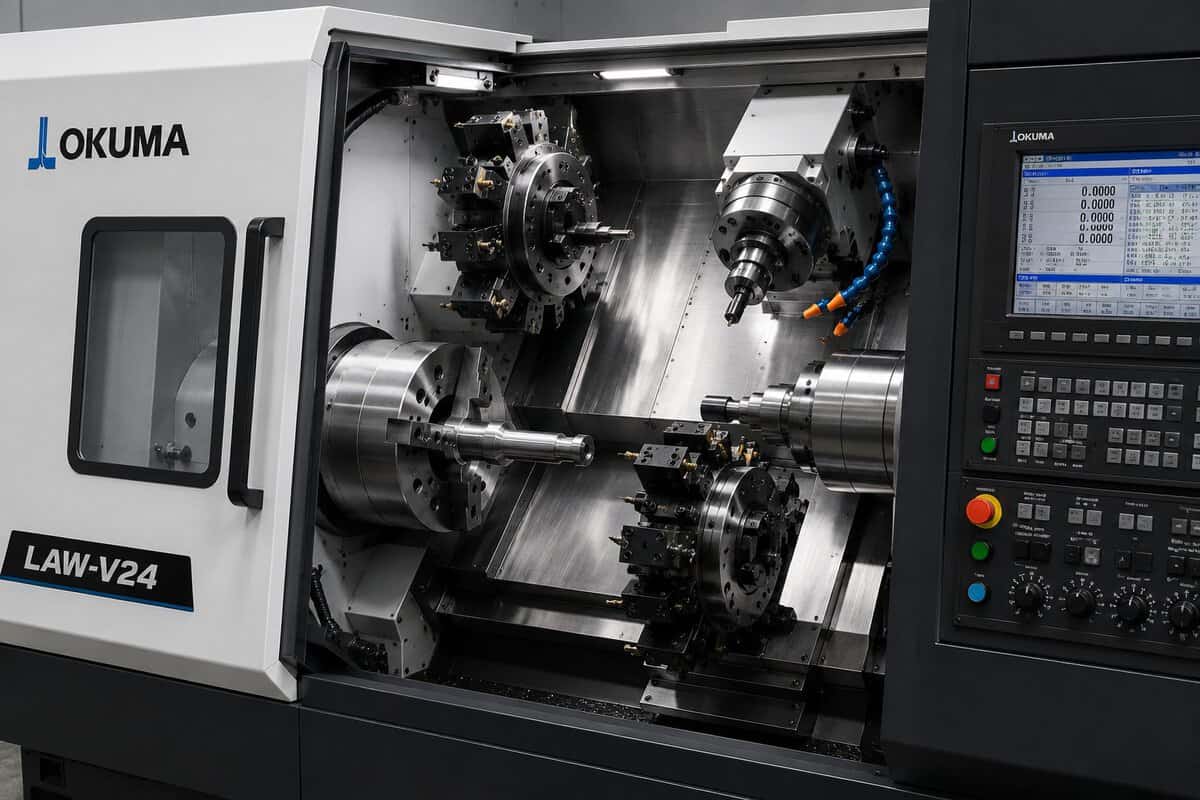
It’s worth being precise about this line, because Okuma sells more than one machine family for wheel work. The V Series (V40R, V100R, V760EX, V920EX) is Okuma’s general-purpose vertical lathe range, built for “thin and odd-shaped workpieces” broadly, of which wheels are one common example. The LAW Series is different: it’s Okuma’s dedicated wheel-machining line, filed under Okuma’s own “Wheel Machines” category, and designed from the ground up around one job — finishing aluminum wheels, from rough casting or forging through to the final mirror, spinner or custom finish cut. If you’re trying to work out which line your machine belongs to and it’s not obvious from the model number, the presence of dual, simultaneously-cutting turrets on a machine sold specifically as a wheel lathe is usually the clearest sign you have a LAW rather than a V Series unit.
The three current LAW models take three different approaches to that same job. The LAW-2S is the workhorse of the range — Okuma states there are more than 2,500 units currently active in production lines across North America — combining two turrets working simultaneously in a 4-axis cycle to cut wheel machining time significantly compared with a single-turret approach. The LAW-V24 goes vertical: gravity pulls chips straight down and away from the cut rather than across the workpiece, which both improves chip clearance and gives superior chucking stability for larger 24-inch wheels, while its two independent 6-station turrets bring the same simultaneous-cutting advantage as the LAW-2S to bigger parts. The LAW-F II takes the opposite approach — a compact, single-turret, 2-axis machine that trades multi-turret throughput for a smaller footprint and a fast turret index, aimed at shops that don’t need the LAW-2S’s dual-turret capacity but still want a dedicated wheel machine rather than a general-purpose lathe pressed into wheel work. Between the three, a shop can match machine capability closely to wheel size and production volume rather than over- or under-buying capacity.
LAW Series Models & Specifications
Each model targets a different combination of wheel size and production volume.
LAW-2S
- Max. turning diameter: 500-630 mm (up to ~20″)
- Spindle speed: up to 3,000 min⁻¹
- Tool stations: 6 / 4 (dual turret)
- Motor: 55/45 kW
- Simultaneous 4-axis turning · 2,500+ active in North America
LAW-V24
- Max. turning diameter: 660 mm (up to 24″)
- Max. turning length: 660 mm
- Spindle speed: up to 3,000 min⁻¹
- Tool stations: 6 / 6 (two independent turrets)
- Motor: 55/45 kW · vertical, gravity-assisted chip fall
LAW-F II
- Wheel capacity: up to 20″
- Configuration: single turret, 2-axis
- Fast turret index for reduced cycle time
- Compact footprint, simplified X/Z travel
Shared Design Features
- Robot- and production-line-friendly design throughout
- Efficient chip handling built around wheel geometry
- Available auto chuck-changing system (LAW-V24)
- “No zero return” 4-axis programming on OSP-equipped models
Which OSP Control Does the LAW Series Use?
Older LAW-V24 machines were commonly fitted with Okuma’s THINC-OSP architecture, roughly equivalent to the OSP-P200 generation. Current LAW-V24 and LAW-2S machines run a standard OSP control with 4-axis simultaneous-turning programming built in — Okuma specifically markets this as removing the need for “zero return” between operations, which matters directly for wheel cycle times since every extra reference move adds up across thousands of parts.
Because Okuma also builds and sells FANUC-controlled machine tools more broadly, it’s worth confirming which control is fitted to your specific LAW machine before ordering parts, the same way we recommend on the V Series — most LAW machines we see are OSP-equipped, but checking the nameplate first avoids any surprises. This is especially worth doing on machines that have changed hands or been relocated since original purchase, since documentation doesn’t always travel with the machine.
Common LAW Series Faults We Repair
Continuous, high-volume wheel production puts a distinctive set of demands on this line, and dual-turret models add their own diagnostic complexity.
Dual-turret synchronization faults (LAW-2S, LAW-V24)
Because both turrets are meant to cut simultaneously to hit the LAW Series’ headline cycle-time advantage, timing drift between them shows up as inconsistent finish quality or near-miss alarms rather than a hard stop. We isolate which turret’s drive or feedback is actually out of tolerance before assuming a control-level synchronization fault, since replacing the wrong turret’s components fixes nothing and costs the client both time and money.
Spindle drive faults under continuous wheel production
High-volume, near-continuous wheel machining puts steady thermal and electrical load on the spindle drive. RPM instability, overheat trips and unusual noise are most often a drive fault rather than a bearing issue, given how robust these spindles are built for exactly this duty cycle — we bench-test the drive before recommending mechanical work.
Auto chuck-changing system faults (LAW-V24)
On LAW-V24 machines with the optional auto chuck-changing system fitted, positioning and clamping faults during a changeover are usually a sensor or actuator issue in the change mechanism itself rather than a spindle or control fault — a distinction that matters, since misdiagnosing this as a spindle problem leads to unnecessary spindle work.
Turret indexing faults (all models)
On the LAW-F II especially, where fast turret index is the machine’s headline productivity feature, indexing delays or missed positions directly cost cycle time — these are almost always mechanical or sensor issues in the turret itself rather than control faults.
Display and operator panel faults
Standard OSP or THINC-OSP panel and display faults follow the same repair pattern as other Okuma lathes, depending on the control generation actually fitted.
Given how much a LAW Series machine typically contributes to a wheel-production line’s total output, we prioritize a fast, correct diagnosis over guesswork — see our fault analysis and testing & diagnostics services for more on our approach.
Components We Repair on the LAW Series
Given the LAW Series’ dedicated, high-volume wheel-production design, these are the parts we’re asked to repair most often:
Spindles
Continuous-duty spindle drive diagnosis and repair.
Control Boards
THINC-OSP and OSP board repair, including 4-axis programming faults.
Servo & Spindle Drives
Dual-turret drive electronics and synchronization tuning.
Turrets
Single and dual-turret indexing motor and sensor repair.
Axis Drives & Ball Screws
X/Z feed system repair across all three LAW configurations.
Operator Panels & Displays
Panel and display repair across THINC-OSP and OSP generations.
LAW Series Repair Services
The following services apply directly to LAW Series machines, whatever the fault:
CNC Control Repair
Board-level repair for THINC-OSP and current OSP controls.
Drive Units Repair
Component-level repair of spindle and turret drive electronics.
Testing & Diagnostics
Practical fault diagnosis before any repair work begins.
Spindle Repair & Maintenance
Service for continuous-duty wheel-machining spindles.
Emergency & Express Repair
Priority turnaround with loaner units to minimize downtime.
Retrofit & Modernization
Upgrade path for older LAW machines on THINC-OSP or legacy controls.
Industries That Rely on the LAW Series
Built purely for wheel production, the LAW Series serves a narrower but very consistent set of customers:
Where We Support LAW Series Machines
CNC Elektronik is based in Germany, at the heart of Europe’s automotive wheel supply chain, so LAW Series repair work is a routine, recurring part of what we do.
We’ve also supported LAW Series repair work in Brazil, where aluminum wheel production for both domestic and export markets makes dedicated wheel lathes a fixture in the automotive supply chain. The process is the same regardless of distance: isolate the failing turret, spindle, or control component through bench testing, repair or replace it, and confirm the machine under real production load — including checking dual-turret synchronization where relevant — before it returns to service. Given how many wheels a single LAW Series machine can push through in a shift, even a brief unplanned stoppage represents a meaningful volume of missed production, which is why we treat these repairs with the same urgency the client’s production schedule demands.
See our Countries We Serve page for our full regional coverage across Europe, the Americas, and parts of Asia and the Middle East.
Explore More Resources
The LAW Series is one part of a much wider Okuma ecosystem. Here’s where to go next:
All Okuma Models
Browse every Okuma machine series and model we repair.
OSP Controls
Every OSP control generation we diagnose and repair.
Automation & Robotics
Robot and line-integration support for wheel production cells.
Components & Parts
Every part type we repair, across the full Okuma range.
Countries We Serve
Where our repair and support coverage extends to.
Spare Parts
New and used Okuma electronics spare parts, tested before sale.
Frequently Asked Questions
The V Series is a general-purpose vertical lathe range that’s commonly used for wheels among other odd-shaped parts. The LAW Series is Okuma’s dedicated wheel-machining line, purpose-built with dual-turret simultaneous cutting and wheel-specific chip handling from the ground up.
The model number is on the machine’s nameplate, and the control generation (THINC-OSP or current OSP) is shown on the control cabinet nameplate or startup screen. Send us a photo of either and we’ll confirm it.
Yes. Faults in the auto chuck-changing mechanism are usually a sensor or actuator issue rather than a spindle problem, and we diagnose and repair this system as part of our standard LAW-V24 service.
Usually not. Each turret has its own drive and control electronics, so we can typically isolate and repair the faulty turret’s components without disturbing the healthy one.
In most cases, yes. Given how many LAW-2S machines in particular remain in daily production use, component-level repair of a control board, drive or turret is almost always far cheaper than replacing a dedicated production machine.
Yes. The LAW Series is specifically designed to be robot- and line-friendly, and we diagnose the CNC side of the integration alongside the lathe itself — see our Automation & Robotics page for more.
Have a LAW Series Issue?
Send us your model number, control type and a description of the fault — we’ll get back to you with a practical assessment.