Monday to Saturday - 8:00 -18:00 (CET/CEST)
Okuma LB Series CNC Lathe Repair & Support
Diagnostics, board-level repair and mechanical service for every Okuma LB Series turning center — from the original LB-EX to the current LB-EX III with OSP-P500.
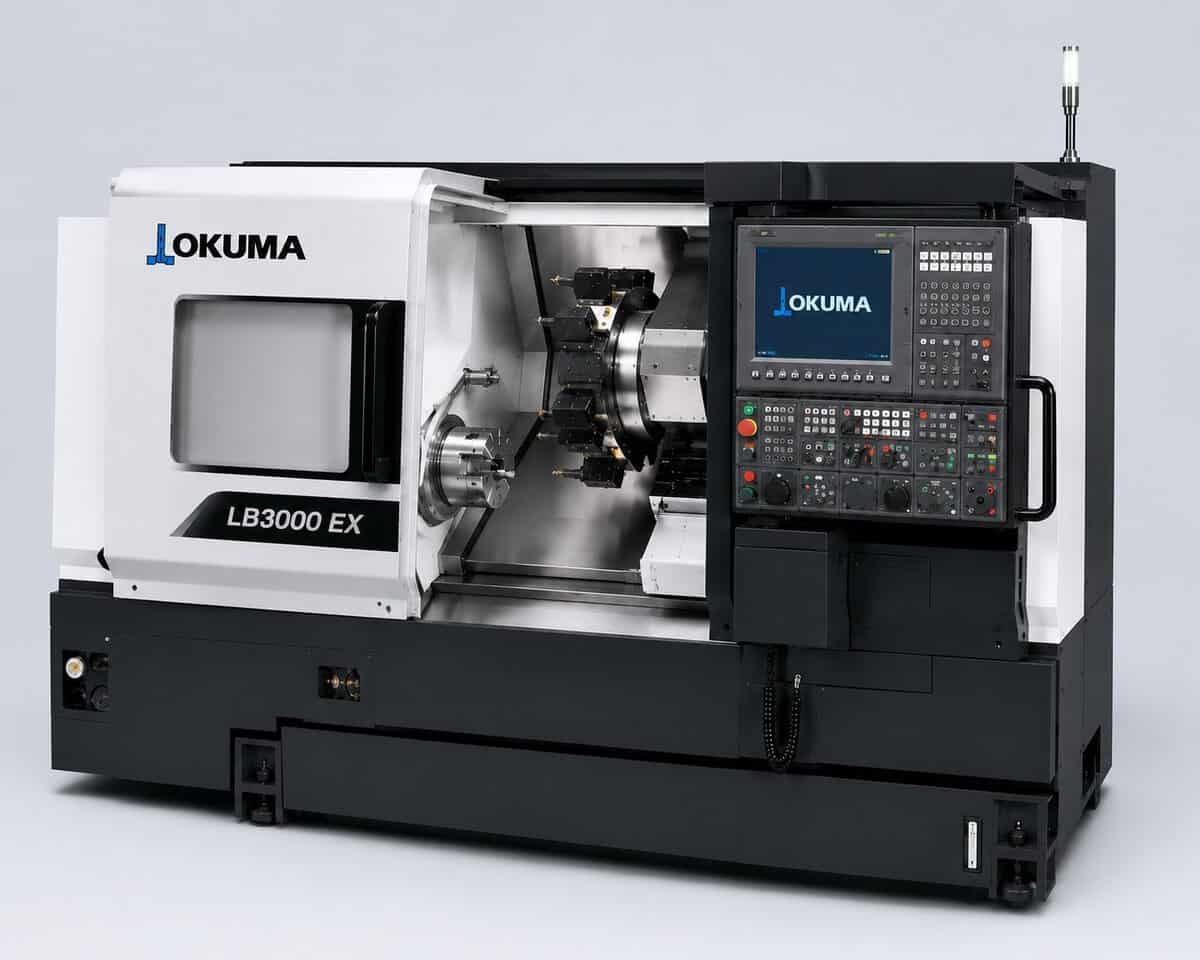
What Is the Okuma LB Series?
The Okuma LB Series is Okuma’s flagship two-axis CNC lathe line — the machine most job shops picture when they think of a general-purpose Okuma turning center. Sold in Europe under the SPACETURN LB EX name and elsewhere simply as the LB or LB-EX series, it has been in continuous production and refinement for well over two decades, making it one of the most widely installed Okuma lathe platforms in active use today.
Built on a box-shaped slant bed and what Okuma calls its Thermo-Friendly Concept, the LB Series is engineered to hold dimensional accuracy as the machine heats up during long production runs — Okuma specifies a machining dimensional change of less than 5 microns over a full shift. Combined with a high-power, high-torque PREX spindle motor and a ball-screw-driven tailstock, the platform is equally comfortable running heavy roughing passes and fine finishing cuts on the same part.
Configuration options are where the LB Series really earns its “flagship” reputation. Beyond the standard L (turning-only) configuration, Okuma offers M (live milling tools on the turret), W (sub-spindle for back-working), Y (Y-axis for off-center milling), and combinations such as MY, MW and MYW — giving a shop dozens of practical configurations from a single base platform. Because so many LB Series machines share the same underlying control and drive architecture across these variants, most electrical and mechanical faults follow recognizable patterns regardless of which specific configuration is on your shop floor — which is exactly why component-level repair is almost always more cost-effective than a full machine replacement.
LB Series Models & Specifications
The LB Series has gone through several generations — EX, EX II and the current EX III — with model numbers referring to swing capacity rather than a strict production year. Below is a summary of the core models we see most often in the field, based on published Okuma specifications.
LB2000 EX / EX II
- Max. turning diameter: 470 mm
- Max. turning length: 300 / 500 mm
- Spindle speed: up to 6,000 min⁻¹
- Turret capacity: 12 tools
- Motor: 11/7.5, 15/11 or 22/15 kW
LB3000 EX / EX II / EX III
- Max. turning diameter: 470 mm
- Max. turning length: 250 / 500 / 1,000 / 1,300 mm
- Spindle speed: up to 5,000 min⁻¹
- Turret capacity: 12 tools
- Motor: 22/15 up to 40/30 kW
LB4000 EX / EX III
- Max. turning diameter: 480 mm
- Max. turning length: 380 / 750 / 1,500 / 2,150 mm
- Spindle speed: up to 4,200 min⁻¹
- Turret capacity: 12 tools
- Motor: 30/22 kW
LB2500 EX, LB35III & LB45III
- Extended-capacity variants of the LB2000/3000/4000 platform
- Same L / M / W / Y feature architecture
- Larger swing and bed-length options for bigger parts
- Shares control and drive electronics with the core LB range
Feature codes are shared across the whole range: L is the standard turning configuration, M adds live milling tools on the turret, W adds a sub-spindle for back-working parts in one setup, and Y adds a Y-axis for off-center milling — with combinations like MY, MW and MYW available on most bed sizes. If you’re not sure which exact variant is on your shop floor, the configuration code is usually printed on the machine’s nameplate next to the model number.
Which OSP Control Does the LB Series Use?
Because the LB Series has been in production for so long, the control fitted to any given machine depends heavily on its age:
- Older LB / LB-EX machines (roughly 2000s-era) typically run OSP-P100 or early OSP-P200 variants such as OSP-P200LA.
- LB-EX II machines (roughly 2010s) commonly run OSP-P300, including the OSP-P300L touchscreen variant.
- Current LB-EX III machines ship with Okuma’s newest OSP-P500 control, described by Okuma as an open-architecture system built to maximize shop-floor utilization and simplify integration with automation.
Knowing your control generation matters when sourcing replacement boards or planning a repair — an OSP-P200-era control board is not interchangeable with an OSP-P300 or OSP-P500 unit. If you’re unsure which generation is fitted to your machine, our CNC control repair team can identify it from the control nameplate or a photo of the operator panel.
Common LB Series Faults We Repair
Because so many LB Series machines are still in daily production use, we see the same handful of fault categories again and again. Below are the most common issues, along with how we typically approach diagnosis and repair.
Spindle drive and orientation faults
Symptoms include spindle alarms on startup, failure to reach commanded RPM, spindle orientation errors before a tool change, or unusual noise/vibration at speed. These are most often traced to the spindle drive unit (VAC-series drive electronics), the spindle encoder, or — less often — the spindle motor windings themselves. We test the drive under load on our bench before condemning the motor, since a faulty drive board is a far more common (and far cheaper) cause than a worn spindle.
Axis servo alarms
Overcurrent, overload or position-deviation alarms on the X or Z axis usually point to a worn ball screw, a failing servo motor, or — most commonly in our experience — a degraded axis drive board or damaged encoder cable. We isolate the fault by swapping known-good components on the bench rather than guessing, which keeps repair costs down.
Turret indexing and ATC faults
A turret that indexes to the wrong station, stalls mid-rotation, or throws a clamp/unclamp alarm is a frequent complaint on higher-hour LB machines. This is usually a turret motor, position sensor, or turret control board issue rather than a mechanical failure of the turret body itself.
Sub-spindle and Y-axis faults (W / Y configurations)
On MW, MYW and similar configurations, sub-spindle synchronization errors and Y-axis positioning faults are common once a machine passes the 10-15 year mark. These faults often trace back to the same drive and encoder issues as the main axes, just on the secondary axis set.
Display, panel and communication faults
Dim, flickering, or dead operator panels, unresponsive touchscreens (on OSP-P300/P500 machines), and intermittent communication errors between the control and drive units round out the most common electronic failures. These are almost always repairable at the board or panel level without replacing the entire control.
In every case, our approach is the same: reproduce the fault, read the alarm history from the OSP control, isolate the failing component through bench testing, then repair or replace only what’s actually broken. See our fault analysis and testing & diagnostics services for more detail on how we work.
Components We Repair on the LB Series
Most LB Series repairs happen at the component level rather than full-unit replacement. The parts we see most often include:
Spindles
Main spindle diagnosis, bearing and runout issues, spindle drive repair.
Control Boards
OSP control board repair — BLD, BLII and SVC board-level work.
Servo & Spindle Drives
Axis and spindle drive repair — VAC, MIV and MFU drive units.
Axis Drives & Ball Screws
X/Z axis feed mechanisms, ball screws and positioning accuracy.
Turrets & Tool Changers
Turret indexing motors, position sensors and control boards.
Operator Panels & Displays
CRT, LCD and touchscreen display repair for OSP control panels.
LB Series Repair Services
Whatever the fault, our core repair services apply directly to LB Series machines:
CNC Control Repair
Board-level repair for OSP-P100 through OSP-P500 control units.
Drive Units Repair
Component-level repair of axis and spindle drive electronics.
Testing & Diagnostics
Practical fault diagnosis before any repair work begins.
Spindle Repair & Maintenance
Mechanical spindle service to restore accuracy and extend life.
Emergency & Express Repair
Priority turnaround with loaner units to minimize downtime.
Retrofit & Modernization
Upgrade path for older LB / LB-EX machines running legacy controls.
Industries That Rely on the LB Series
As Okuma’s flagship general-purpose lathe, the LB Series shows up across a wide range of production environments:
Where We Support LB Series Machines
CNC Elektronik is based in Germany, and the majority of our day-to-day LB Series repair work happens for shops across Germany and neighboring European countries. Our workshop handles both bench repairs on removed boards and drives, and on-site diagnostics when a machine can’t easily be shipped.
Beyond our core European base, we’ve also completed LB Series repair work further afield — including projects in Brazil, one of South America’s largest automotive and general manufacturing hubs, where Okuma lathes are common in both automotive supply chains and independent job shops. Whether a machine is down the road or on another continent, the diagnostic and repair process is the same: identify the fault, repair or replace the failed component, and test under real load before it goes back into production.
See our Countries We Serve page for the full list of regions where we support customers, including our coverage across Europe, North and South America, and parts of Asia and the Middle East.
Explore More Resources
The LB Series is one part of a much wider Okuma ecosystem. Here’s where to go next:
All Okuma Models
Browse every Okuma machine series and model we repair.
OSP Controls
Every OSP control generation we diagnose and repair.
Automation & Robotics
Support for gantry loaders and bar feeders fitted to LB machines.
Components & Parts
Every part type we repair, across the full Okuma range.
Countries We Serve
Where our repair and support coverage extends to.
Spare Parts
New and used Okuma electronics spare parts, tested before sale.
Frequently Asked Questions
The model number and configuration code (L, M, W, Y or a combination) are printed on the machine’s main nameplate, usually near the operator door. The control generation is shown on the OSP control’s own nameplate or splash screen at startup. If you’re unsure, send us a photo of either and we’ll confirm it for you.
Yes. We regularly repair OSP-P200-era boards at the component level, and where a board is beyond economical repair, we can advise on retrofit and modernization options to bring an older machine onto a currently supported control.
For time-critical repairs, our emergency & express repair service includes loaner units where available, so your machine doesn’t have to sit idle waiting for a board to come back from the bench.
In most cases, yes. Component-level repair of a control board, drive unit or spindle is almost always a fraction of the cost of a replacement machine, and a well-maintained LB Series lathe with a solid mechanical base can run reliably for decades once the electronics are sorted.
Yes. Many LB Series lathes run with a bar feeder or an Okuma Gantry Loader (OGL) for unattended production. Faults on these peripherals are often electrical rather than mechanical, and we diagnose and repair the loader’s control interface alongside the machine itself. See our Automation & Robotics page for more on the loader and feeder types we support.
Have an LB Series Issue?
Send us your model number, control type and a description of the fault — we’ll get back to you with a practical assessment.