Monday to Saturday - 8:00 -18:00 (CET/CEST)
Okuma TWIN STAR LT Series Repair & Support
Diagnostics and repair for Okuma’s twin-spindle, twin-turret turning centers — the LT2000 EX and LT3000 EX, built for complete part machining without a second setup.
What Is the Okuma TWIN STAR LT Series?
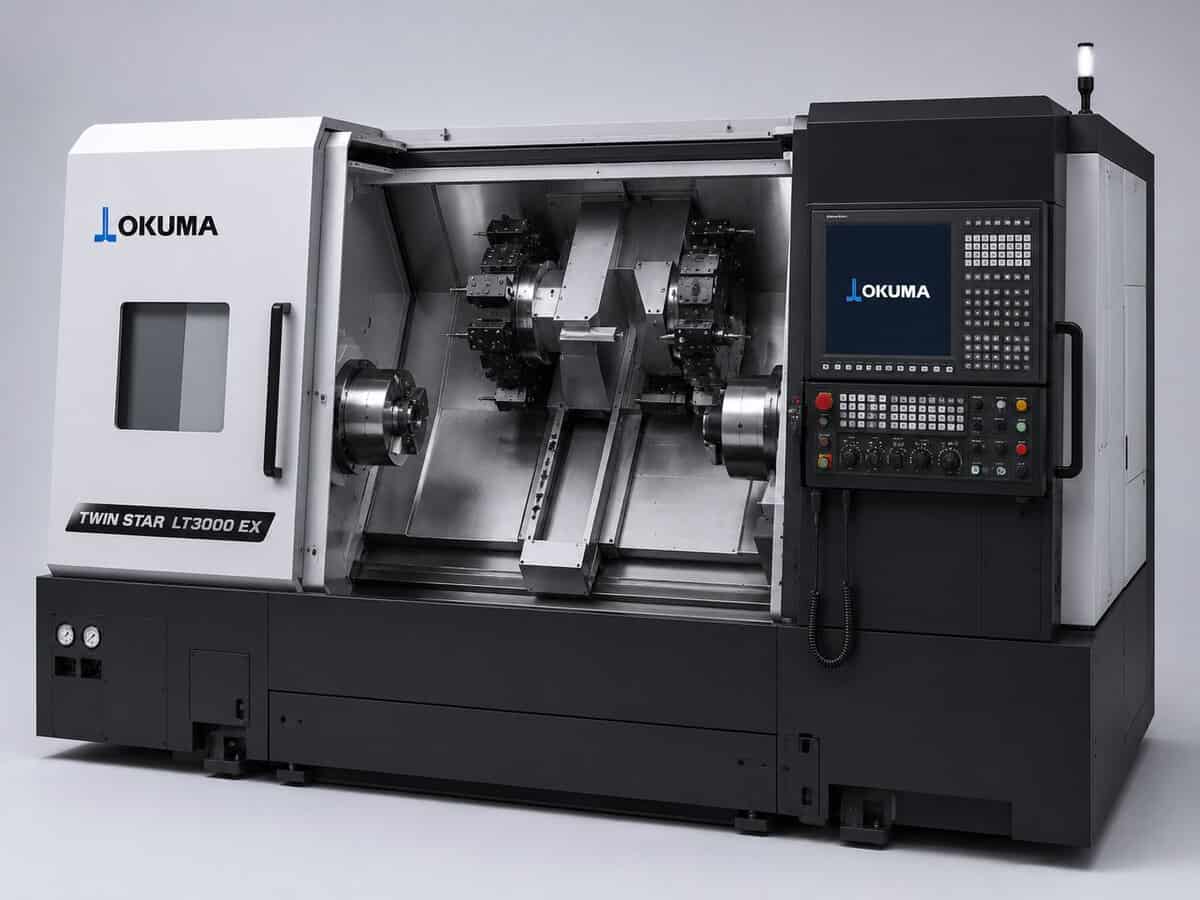
The TWIN STAR LT Series takes a different approach to complete-part machining than either the LB or LU Series. Instead of one spindle with an optional sub-spindle, or two turrets on one spindle, the LT2000 EX and LT3000 EX carry two full spindles — left and right — paired with two or three turrets that can work with either spindle. A part can be machined complete, front and back, without ever being removed from the machine, and the same program can run on either turret or either spindle, since the OSP control automatically flips the part geometry.
What makes this genuinely different from a standard main-spindle-plus-sub-spindle lathe is Okuma’s part-transfer technology: the workpiece can move from the left spindle to the right spindle while both are rotating, using what Okuma calls Torque Synchronization and Torque Skip — the right spindle can feed against the part face at a controlled force while the left spindle simultaneously releases it, even on irregular, non-round geometries. Combined with a Collision Avoidance System that lets both turrets run at full speed without operators having to program in extra safety margins, the LT Series is built for shops that need to machine complex parts end-to-end at high volume, not just occasionally use a sub-spindle for back-working. Okuma also builds in a Thermo-Friendly Concept and High-Response Positioning System on this platform, using sensors throughout the base and headstocks to predict and compensate for thermal deformation as the machine warms up during a production run.
TWIN STAR LT Series Models & Specifications
Both current LT Series models share the same twin-spindle, twin/triple-turret architecture, scaled to two different chuck classes.
LT2000 EX
- Max. turning diameter: 250 mm
- Main spindle: 15/11 kW, up to 5,000-6,000 min⁻¹
- Sub-spindle: 11/7.5 kW, up to 5,000 min⁻¹
- Chuck class: 8″ · A2-6 spindle nose
- Tool stations: 32 (2-turret) / 48 (3-turret)
LT3000 EX
- Spindle speed: up to 5,000 min⁻¹ (standard)
- Motor: 22/15 kW (30 min/cont)
- Spindle torque: 427/280 N·m
- Chuck class: 8-10″ · A2-8 spindle nose
- Configuration: 2 or 3-turret, with or without Y-axis
Both models are available in 2-turret or 3-turret configurations, each with or without a Y-axis, so a shop can size the machine to the complexity of the parts it runs rather than the other way around. Every turret integrates lathe and mill/drill functions, meaning live tooling is standard equipment, not an add-on.
Which OSP Control Does the TWIN STAR LT Series Use?
Current LT2000 EX and LT3000 EX machines run Okuma’s open-architecture, PC-based OSP-P300 control, specifically the OSP-P300LA variant with a 15-inch color TFT display. Built around Okuma’s “Easy Operation” concept, the control groups commonly used twin-spindle and twin-turret processes together — a deliberate design choice given how much more complex programming a twin-spindle, multi-turret machine is compared with a standard single-turret lathe.
Because the LT Series’ twin-spindle geometry-flip and collision-avoidance logic run inside the OSP control itself, board-level faults here can affect production in ways that go beyond a typical control fault — which is exactly why correctly diagnosing whether an issue sits in the control, the drive, or the mechanical transfer system matters more on this platform than on a simpler lathe. A control fault that only affects the transfer logic, for example, can look identical from the operator’s seat to a mechanical fault in the transfer mechanism itself, and getting that distinction right the first time avoids paying for parts that were never actually broken.
Common TWIN STAR LT Series Faults We Repair
The LT Series’ twin-spindle part-transfer and multi-turret design create fault patterns you simply don’t see on single-spindle Okuma lathes.
Spindle transfer and torque synchronization faults
Faults during the left-to-right part transfer — dropped parts, transfer timing errors, or torque-skip alarms during the handoff — are the most distinctive LT Series issue we see. These almost always trace back to a drive or feedback fault on one of the two spindles rather than a problem with the transfer logic itself, since the synchronization program running in the OSP control is rarely the actual point of failure. A shop that hasn’t worked with a twin-spindle machine before will often assume the fault is in the “handshake” between spindles, when in practice it’s usually a conventional drive or encoder fault on whichever spindle is misbehaving.
Collision Avoidance System faults
Nuisance trips or false collision alarms from the Collision Avoidance System usually point to a position-feedback discrepancy on one of the turrets rather than a genuine collision risk — but because this system is a genuine safety feature, we never simply disable or bypass it; we trace the underlying feedback fault so the system keeps working as designed.
Turret indexing faults across 2 or 3 turrets
With up to three turrets, each capable of working with either spindle, indexing faults need to be isolated to the correct turret before any repair starts. On 3-turret machines especially, we’ve seen shops assume a fault affects the whole machine when it’s actually isolated to a single turret’s drive electronics.
Left and right spindle drive faults
Because the main and sub-spindle have different power ratings and operate independently, drive faults on the two sides present differently — a fault on the lower-powered sub-spindle drive can look like a transfer problem if you’re not checking each spindle’s electronics separately from the start.
Display and operator panel faults
The 15-inch color TFT display on OSP-P300LA machines is a common repair item on higher-hour machines — usually a backlight or panel issue rather than a deeper control fault.
Given how much diagnostic complexity the twin-spindle, multi-turret design adds, we lean heavily on the OSP alarm history to isolate exactly which spindle, turret or transfer stage is at fault before opening anything up. See our fault analysis and testing & diagnostics services for more on our approach.
Components We Repair on the TWIN STAR LT Series
Given the LT Series’ twin-spindle, multi-turret design, these are the parts we’re asked to repair most often:
Spindles
Independent left and right spindle drive and encoder repair.
Control Boards
OSP-P300LA board-level repair, including transfer-logic faults.
Servo & Spindle Drives
Dual-spindle drive electronics for main and sub-spindle sides.
Turrets & Tool Changers
Indexing motors and sensors across 2 or 3 turret configurations.
Axis Drives & Ball Screws
Feed system repair, including Y-axis on Y-configured turrets.
Operator Panels & Displays
15-inch color TFT display and touchscreen repair.
TWIN STAR LT Series Repair Services
The following services apply directly to TWIN STAR LT Series machines, whatever the fault:
CNC Control Repair
Board-level repair for OSP-P300LA control units.
Drive Units Repair
Component-level repair of twin-spindle and turret drives.
Testing & Diagnostics
Practical fault diagnosis before any repair work begins.
Spindle Repair & Maintenance
Service for both main and sub-spindle sides.
Emergency & Express Repair
Priority turnaround with loaner units to minimize downtime.
Retrofit & Modernization
Upgrade path for older TWIN STAR LT machines on legacy controls.
Industries That Rely on the TWIN STAR LT Series
Its ability to machine complete parts front-to-back in one setup makes the LT Series well suited to:
Where We Support TWIN STAR LT Series Machines
CNC Elektronik is based in Germany, where most of our TWIN STAR LT Series repair work is carried out — either on the bench once a control board or drive has been shipped to us, or on-site when a machine can’t be moved.
We’ve also supported LT Series repair work in Brazil, where twin-spindle turning centers are increasingly common in automotive component manufacturing that needs complete, front-to-back parts without secondary operations. The repair process is the same regardless of distance: isolate which spindle, turret or transfer stage is at fault, repair or replace the failed component, and confirm the machine under real production load before it returns to service. For a machine running two spindles and multiple turrets, we find that clients place particular value on getting a clear, specific diagnosis before any parts are ordered, since a wrong guess on this platform can be an expensive one.
See our Countries We Serve page for our full regional coverage across Europe, the Americas, and parts of Asia and the Middle East.
Explore More Resources
The TWIN STAR LT Series is one part of a much wider Okuma ecosystem. Here’s where to go next:
All Okuma Models
Browse every Okuma machine series and model we repair.
OSP Controls
Every OSP control generation we diagnose and repair.
Automation & Robotics
Support for gantry loaders and bar feeders fitted to LT machines.
Components & Parts
Every part type we repair, across the full Okuma range.
Countries We Serve
Where our repair and support coverage extends to.
Spare Parts
New and used Okuma electronics spare parts, tested before sale.
Frequently Asked Questions
The model number and turret/Y-axis configuration are printed on the machine’s nameplate. If you’re not sure whether you have a 2-turret or 3-turret machine, count the tool turrets directly, or send us a photo and we’ll confirm it.
The LU Series has two turrets on a single spindle, built for large, heavy shaft-type parts. The TWIN STAR LT Series has two full spindles plus two or three turrets, built for complete front-and-back machining of smaller, more complex parts without re-fixturing.
Yes. Most transfer faults trace back to a drive or feedback issue on one of the two spindles, which we diagnose and repair at the component level rather than treating the transfer logic itself as the fault.
Not necessarily. Nuisance trips are often a position-feedback discrepancy rather than a genuine risk, but we always trace the root cause rather than disabling the system, since it’s a genuine safety feature.
In most cases, yes. Given the investment a twin-spindle, multi-turret machine represents, component-level repair of a control board, drive or turret is almost always far cheaper than replacement — and these machines are built for long service life once the electronics are sorted.
Yes. Many LT Series machines run with a bar feeder for unattended production of small-to-mid parts. We diagnose the loader’s control interface alongside the lathe — see our Automation & Robotics page for the automation types we support.
Have a TWIN STAR LT Series Issue?
Send us your model number, control type and a description of the fault — we’ll get back to you with a practical assessment.