Monday to Saturday - 8:00 -18:00 (CET/CEST)
Okuma LU Series CNC Lathe Repair & Support
Diagnostics and repair for Okuma’s twin-turret SIMUL TURN lathes — from the LU35/LU45 range through the current LU3000 EX, LU4000 EX and LU7000 EX.
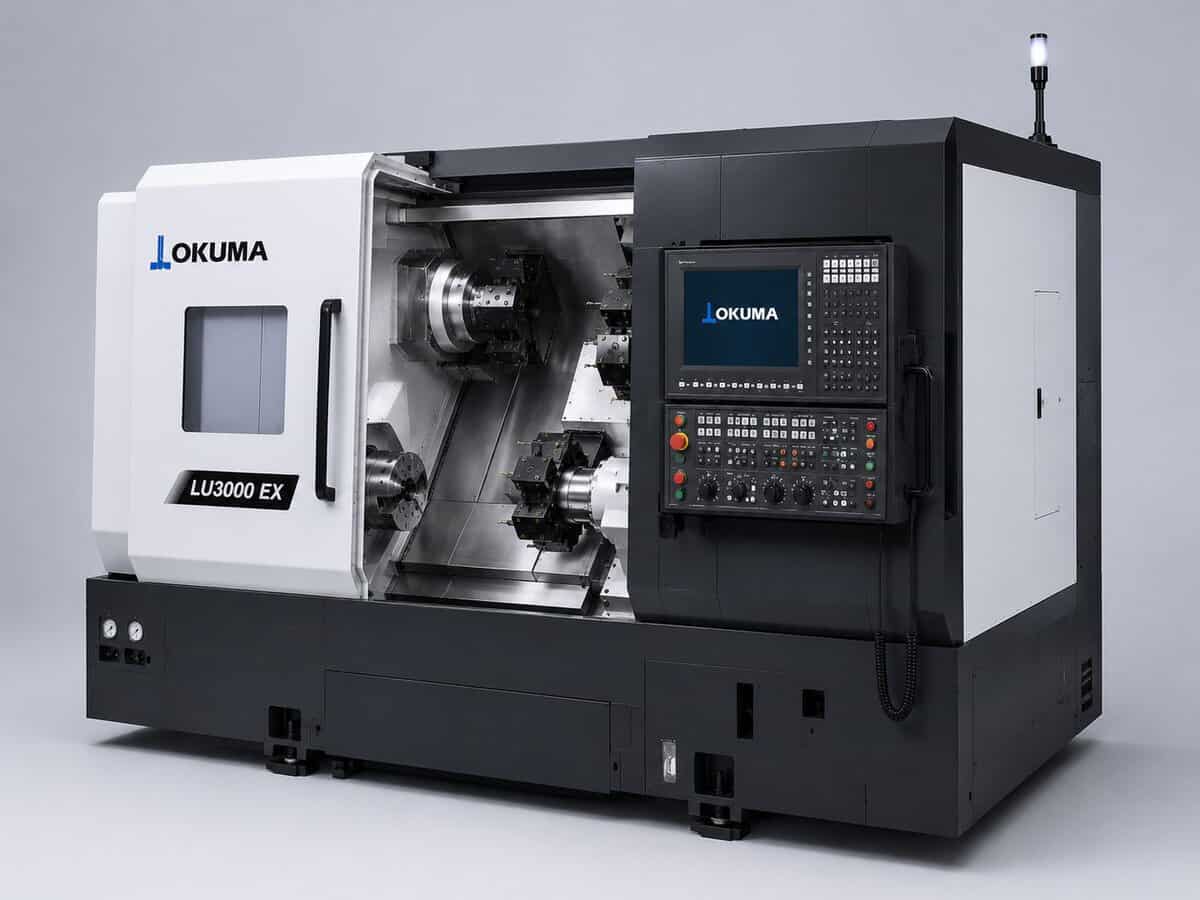
What Is the Okuma LU Series?
The LU Series is Okuma’s large-capacity 4-axis turning platform, built around a genuinely different concept to the LB or GENOS L Series: rather than one turret and an optional sub-spindle, every LU machine carries two independent turrets — an upper and a lower — that can cut simultaneously on the same part. Okuma markets this as SIMUL TURN, and the practical result is real: two tools removing material at once on a heavy shaft-type part routinely cuts cycle times by around a third compared with an equivalent single-turret setup.
That twin-turret layout, combined with an oversized, hand-scraped box-way bed and torque-heavy drives, is what makes the LU Series Okuma’s go-to line for parts with a large length-to-diameter ratio — long shafts, spindles, and similar components — and for hard-to-machine materials, including hardened-steel hard turning. The smaller LU3000 EX works in the 8-10 inch chuck class with a 45-degree box bed and a three-point-supported spindle bearing arrangement for long-term accuracy; the LU7000 EX scales the same twin-turret concept up to parts as large as 900mm in turning diameter.
Because both turrets are independently driven and positioned, an LU Series machine is mechanically and electrically more complex than a single-turret lathe of similar size — which also means fault diagnosis benefits from experience with this specific platform rather than general lathe troubleshooting. A technician used to single-turret Okuma lathes can misdiagnose a turret-specific fault as a general machine issue if they’re not used to checking each turret’s electronics independently, which is exactly the kind of mistake that leads to unnecessary parts being replaced.
LU Series Models & Specifications
Okuma has offered the LU platform across several size classes and generations — LU35/LU45 (later LU35II/LU45II) and the current LU3000/LU4000/LU7000 EX range. Specifications below are drawn from published Okuma figures.
LU3000 EX
- Max. turning diameter: 410 mm
- Max. turning length: 350 / 600 / 1,000 mm
- Spindle speed: up to 5,000 min⁻¹
- Turret capacity: 12 (upper) / 8 (lower)
- Motor: 22/15 up to 30/20 kW
LU4000 EX
- Larger-capacity sibling of the LU3000 EX
- Same twin-turret, dual independent saddle layout
- Aimed at heavier shaft-type components
- Shares control and drive electronics with LU3000 EX
LU7000 EX
- Max. turning diameter: 900 mm
- Max. turning length: 2,000 mm
- Spindle speed: up to 1,500 min⁻¹
- Turret capacity: 12 (upper) / 10 (lower)
- Motor: 45/37 up to 75/60 kW
LU35 / LU35II / LU45II
- Max. turning diameter: 550 mm (LU35II)
- Max. turning length: 920 / 1,570 / 2,070 mm
- Spindle speed: up to 3,200 min⁻¹
- 22 tool stations across upper (12) and lower (10) turrets
Feature codes follow the same logic as other Okuma lathes: L is standard turning, M adds live milling tools, MY adds a Y-axis, and W adds a sub-spindle — available in combination with the twin-turret layout on most LU EX models, along with optional gantry loader integration.
Which OSP Control Does the LU Series Use?
Older LU35/LU45 machines were built around Okuma’s THINC-OSP architecture, roughly equivalent to the OSP-P200 generation, known for strong 4-axis simultaneous-turning programming. Many LU3000 EX and LU4000 EX units in the field run OSP-P300, while Okuma’s current LU3000 EX ships with the newest OSP-P500 control, built around a single-screen “easy operation” interface designed to make twin-turret programming approachable for operators of any experience level.
Given the spread of control generations across the LU range, confirming exactly which OSP version is fitted matters before ordering replacement boards — the nameplate on the control cabinet, or a photo of the startup screen, is usually enough for us to confirm it. Because the LU Series has been sold over such a long production run, it’s not unusual for us to see two machines of the same model number running noticeably different control generations depending on when each was manufactured and whether it’s been retrofitted.
Common LU Series Faults We Repair
Most of the faults we see on LU Series machines relate directly to the twin-turret architecture and the heavier cutting loads the platform is built for.
Twin-turret synchronization and collision faults
Because the upper and lower turrets can be programmed to cut simultaneously, timing or positioning errors between the two show up as near-misses, tool collisions, or alarms flagging an out-of-sync condition. These are almost always traced to one turret’s drive or position feedback drifting relative to the other, rather than a fault affecting both equally — isolating which turret’s electronics are at fault is the first step in every LU Series repair we do, and it’s the single most common reason a shop calls us rather than attempting an in-house fix.
Spindle drive and bearing faults
The LU Series’ three-point spindle bearing support is built for long service life under heavy cutting loads, but on higher-hour machines running hard-turning applications we still see spindle drive alarms, RPM instability and bearing-related runout. As with other Okuma lathes, we bench-test the drive electronics before recommending any spindle rebuild, since a failing drive board is far more common than a genuinely worn bearing.
Axis servo alarms on dual independent saddles
With two independently driven saddle systems instead of one, axis overload and position-deviation alarms need to be traced to the correct saddle before any repair starts. We treat each saddle’s drive and encoder as a separate diagnostic path rather than assuming a fault on one axis set implies the same fault exists on the other.
Hard-turning drive overload faults
Because the LU Series is specifically marketed for hard-to-machine materials and hard turning, we see more drive-overload and thermal-protection trips here than on general-purpose lathes running lighter cuts. This is usually a sign the drive electronics are protecting the machine correctly rather than a fault in themselves, but repeated trips warrant a full drive inspection to rule out a genuine developing fault, particularly on machines that have been running the same hard-turning program for several years without a break in duty cycle.
Display and communication faults
Operator panel and touchscreen faults follow the same pattern as other OSP-equipped Okuma lathes — more common on older THINC-OSP and OSP-P200 units, and more often digitizer-related on OSP-P300/P500 touchscreens.
On every LU Series repair, we start by identifying which turret, saddle or axis is actually at fault using the OSP alarm history, then isolate the failing component on the bench rather than guessing. See our fault analysis and testing & diagnostics services for more on our approach.
Components We Repair on the LU Series
Given the LU Series’ twin-turret, dual-saddle design, these are the parts we’re asked to repair most often:
Spindles
Heavy-duty spindle drive and three-point bearing diagnosis.
Control Boards
THINC-OSP, OSP-P300 and OSP-P500 board-level repair.
Servo & Spindle Drives
Heavy-load drive electronics for both turret systems.
Axis Drives & Ball Screws
Dual independent saddle feed systems and box-way accuracy.
Upper & Lower Turrets
Twin-turret indexing motors, sensors and synchronization faults.
Operator Panels & Displays
CRT, LCD and touchscreen repair across all OSP generations.
LU Series Repair Services
The following services apply directly to LU Series machines, whatever the fault:
CNC Control Repair
Board-level repair for THINC-OSP through OSP-P500 units.
Drive Units Repair
Component-level repair of heavy-duty spindle and axis drives.
Testing & Diagnostics
Practical fault diagnosis before any repair work begins.
Spindle Repair & Maintenance
Heavy-duty spindle service to restore accuracy and extend life.
Emergency & Express Repair
Priority turnaround with loaner units to minimize downtime.
Retrofit & Modernization
Upgrade path for older LU35/LU45 machines on legacy controls.
Industries That Rely on the LU Series
The LU Series’ twin-turret capacity and hard-turning strength make it a natural fit for:
Where We Support LU Series Machines
CNC Elektronik is based in Germany, where the majority of our LU Series repair work is carried out — either on the bench after boards or drives are shipped to us, or on-site when a machine is too large or too busy to move.
We’ve also supported LU Series repairs further afield, including work in Brazil, where heavy shaft-type production for automotive and energy-sector manufacturing makes twin-turret Okuma lathes a common fixture on the shop floor. Distance doesn’t change the process: identify the faulty turret, saddle or control component, repair or replace it, and confirm the machine under real cutting load before it returns to production. For a machine of this size and importance to a production line, minimizing the time between fault and repair is usually the client’s top priority, which is why we prioritize clear diagnosis over guesswork from the first contact.
See our Countries We Serve page for our full regional coverage across Europe, the Americas, and parts of Asia and the Middle East.
Explore More Resources
The LU Series is one part of a much wider Okuma ecosystem. Here’s where to go next:
All Okuma Models
Browse every Okuma machine series and model we repair.
OSP Controls
Every OSP control generation we diagnose and repair.
Automation & Robotics
Support for gantry loaders and bar feeders fitted to LU machines.
Components & Parts
Every part type we repair, across the full Okuma range.
Countries We Serve
Where our repair and support coverage extends to.
Spare Parts
New and used Okuma electronics spare parts, tested before sale.
Frequently Asked Questions
The model designation is printed on the machine’s nameplate, and the control generation (THINC-OSP, OSP-P300, OSP-P500) shows on the control cabinet nameplate or startup screen. Send us a photo of either and we’ll confirm it before quoting a repair.
The LB Series is a single-turret, two-axis lathe. The LU Series carries two independent turrets that can cut simultaneously, is built for larger and heavier parts, and is specifically marketed for hard-to-machine materials and hard turning.
Yes. We repair THINC-OSP and OSP-P200-era boards at the component level, and can advise on retrofit and modernization if a board is beyond economical repair.
Usually not. Because each turret has its own drive and control electronics, we can typically isolate and repair the faulty turret’s components without disturbing the other, healthy turret.
In most cases, yes. Given the size and cost of the LU Series, component-level repair of a turret, drive or control board is a small fraction of the cost of a replacement — and the platform’s heavy-duty build means a well-maintained machine can stay in productive service for decades.
Yes. Several LU Series machines run with an Okuma Gantry Loader for unattended production of shaft-type parts. We diagnose and repair the loader’s control interface alongside the lathe itself — see our Automation & Robotics page for the automation types we support.
Have an LU Series Issue?
Send us your model number, control type and a description of the fault — we’ll get back to you with a practical assessment.