Monday to Saturday - 8:00 -18:00 (CET/CEST)
Okuma GENOS L Series CNC Lathe Repair & Support
Board-level electronics repair and mechanical service for Okuma’s compact “Affordable Excellence” turning centers — from the original GENOS L to the current L250II-e and L400II-e.
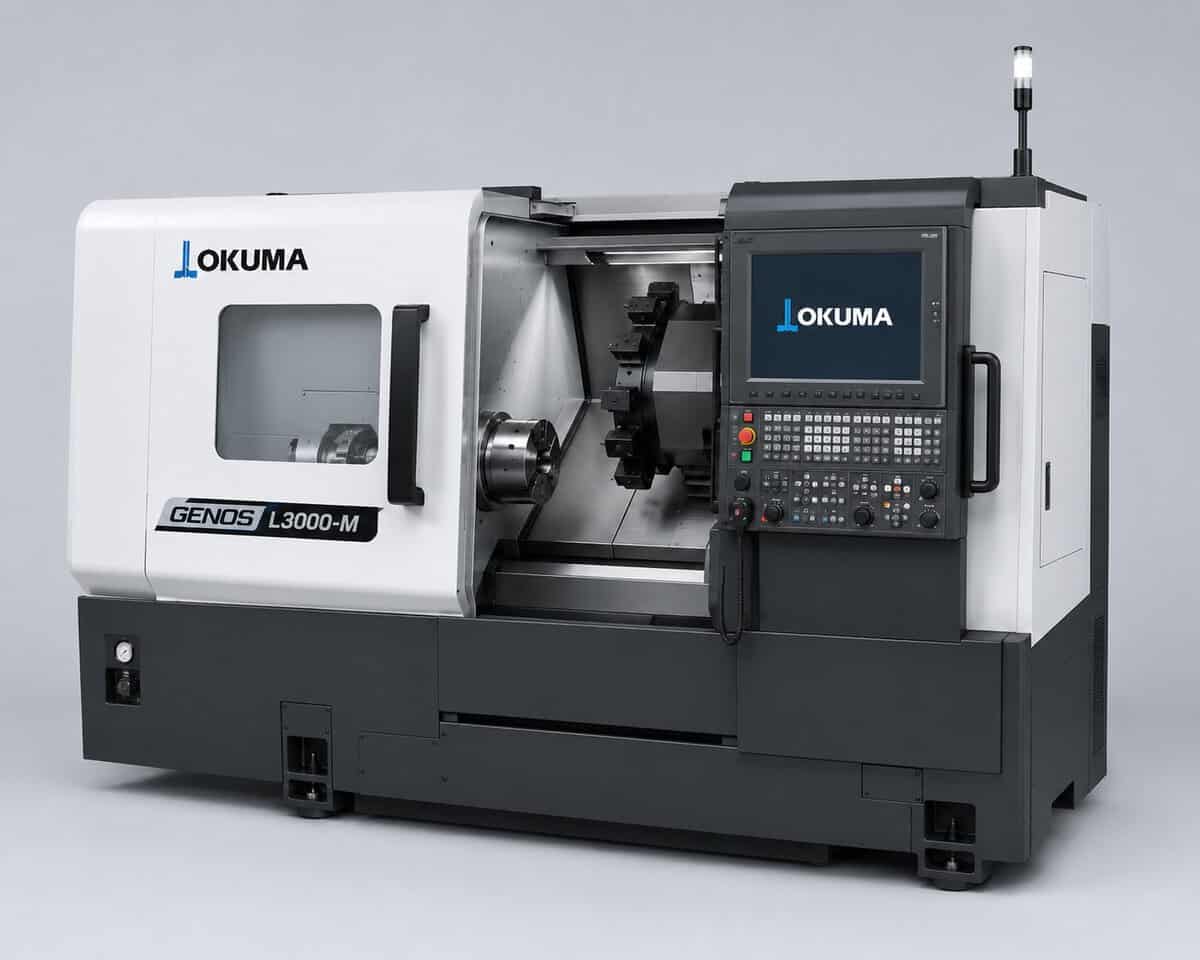
What Is the Okuma GENOS L Series?
The GENOS L Series is Okuma’s compact, entry-level turning center line — marketed under the “Affordable Excellence” banner as a way to get genuine Okuma-grade accuracy and thermal stability into a smaller footprint and a smaller budget than the flagship LB Series. Built at Okuma’s Oguchi plant in Japan, GENOS L machines are aimed squarely at shops producing small-to-mid-size parts: precision components under roughly 250-400mm in turning diameter, often for medical instrument makers, automotive fittings and general high-mix job shops.
The defining technical feature of the GENOS L Series is its integral spindle motor. Rather than driving the spindle through a belt (the traditional approach on many entry-level lathes), the motor is built directly into the spindle housing. This eliminates belt-related vibration and slip, which in practice means better surface finish and more consistent thermal behavior — the same design philosophy Okuma uses on its larger, more expensive lathes, just scaled down. The machine sits on a one-piece cast iron base, with hand-scraped headstock and tailstock mounting surfaces for long-term rigidity.
Where the GENOS L Series differs most from the LB Series in daily use is automation. Several GENOS L models are specifically built to connect to an Okuma Gantry Loader (OGL) or bar feeder for unattended production, and the current GENOS L3000-e is explicitly built to connect with Okuma’s STANDROID robot package — making it a common choice for shops automating a single-machine cell rather than running a full multi-spindle production line. This automation-first design also shapes the kinds of electrical faults we see on the GENOS L Series day to day, which is why we’ve broken them out separately below.
GENOS L Series Models & Specifications
Okuma has refreshed the GENOS L range a few times — early GENOS L machines, the “-e” refresh, and the current GENOS LII “-e” generation — but the core four size classes have stayed consistent. Specifications below are drawn from published Okuma figures for the current generation.
GENOS L250 / L250II-e
- Max. turning diameter: 220 mm
- Max. turning length: 290 / 500 mm
- Spindle speed: up to 4,500-6,000 min⁻¹
- Turret capacity: 12 tools
- Motor: 11/7.5 kW
GENOS L2000-e
- Max. turning diameter: 200-230 mm
- Max. turning length: 290 / 380 / 500 mm
- Spindle speed: up to 5,000 min⁻¹
- Turret capacity: 12 tools
- Motor: 15/11 kW · OGL gantry loader compatible
GENOS L3000-e
- Max. turning diameter: 300-390 mm
- Max. turning length: 500 / 1,100 mm
- Spindle speed: up to 3,800 min⁻¹
- Turret capacity: 12 tools
- Motor: 22/15 kW · connectable with STANDROID
GENOS L400 / L400II-e
- Max. turning diameter: 310-330 mm
- Max. turning length: 500 / 1,100 mm
- Spindle speed: up to 3,000 min⁻¹
- Turret capacity: 12 tools
- Motor: 15/11 kW
As with Okuma’s other turning centers, feature codes describe what’s fitted: L is standard turning only, M adds live milling tools on the turret, MY adds a Y-axis for off-center milling, and MYW adds a sub-spindle on top of that — available on the larger L3000-e. If your machine has an OGL badge or a STANDROID cell attached, that’s the automation option, not a separate model line.
Which OSP Control Does the GENOS L Series Use?
GENOS L machines built in the early-to-mid 2010s commonly shipped with OSP-P200, specifically the OSP-P200LA variant seen on machines from around 2013. Slightly newer units moved to OSP-P300, in the OSP-P300L-R configuration — the “R” typically denoting a specific regional or revolver-turret configuration.
Because the GENOS L line is positioned as an entry-level, cost-conscious platform, we more often see it paired with the OSP-P200 and OSP-P300 generations than with Okuma’s newest OSP-P500 control — though as Okuma continues to update the range, newer units may well ship with it. If you’re not certain which generation your machine has, check the nameplate on the control cabinet or send us a photo of the operator panel and we’ll confirm it before quoting any repair.
Common GENOS L Series Faults We Repair
The GENOS L Series shares some fault patterns with other Okuma lathes, but its integral spindle design and automation-focused configurations mean a few issues show up more specifically here than on other lines.
Integral spindle motor faults
Because the spindle motor is built directly into the spindle housing rather than driven through a belt, a failing integral spindle presents differently to a belt-driven one — there’s no belt to inspect or replace, so symptoms like RPM instability, overheat alarms or unusual noise almost always point straight to the drive electronics or the motor windings themselves. We test the spindle drive on the bench under simulated load before recommending motor work, since drive faults are both more common and considerably cheaper to fix.
Axis feed and Servo Navi faults
GENOS L machines running Okuma’s Servo Navi L feature (automatic feed-rate and vibration tuning) can throw alarms when the calibration drifts, usually presenting as inconsistent surface finish or occasional axis overload alarms rather than a hard stop. This is typically a parameter or drive-board issue rather than a worn mechanical component, and it’s usually resolved without needing to touch the ball screw or guideways.
Gantry loader and bar feeder faults
On GENOS L2000-e and similar machines fitted with an Okuma Gantry Loader (OGL) or a third-party bar feeder, most faults we see are in the loader’s own control interface or its handshake signals with the OSP control — parts not indexing correctly, loader timeouts, or the machine refusing to cycle with the loader attached. These are almost always electrical faults in the loader interface rather than problems with the lathe itself.
STANDROID and automation interface faults
On GENOS L3000-e cells connected to a STANDROID robot, communication faults between the robot controller and the OSP control are the most common issue — typically a configuration or interface-board problem rather than a robot mechanical fault. We diagnose the CNC side of this connection and can coordinate with your automation integrator where the fault sits on the robot side.
Display and operator panel faults
As with any OSP control, dim or dead displays and unresponsive panels are a routine repair — on OSP-P200LA machines this is usually a CRT or early LCD panel issue, while OSP-P300 machines more often show touchscreen digitizer faults rather than backlight failure.
Across all of these, our process stays the same: reproduce the fault, check the OSP alarm history, isolate the failing component on the bench, and repair or replace only what’s actually broken. See our fault analysis and testing & diagnostics services for more on our approach.
Components We Repair on the GENOS L Series
Given the GENOS L Series’ integral spindle and automation-friendly design, these are the parts we’re asked to repair most often:
Spindles
Integral spindle diagnosis, direct-drive motor and encoder repair.
Control Boards
OSP-P200LA and OSP-P300 board-level repair.
Servo & Spindle Drives
Drive electronics repair for integral spindle and axis motors.
Axis Drives & Ball Screws
X/Z feed mechanisms and Servo Navi calibration issues.
Turrets & Tool Changers
12-station turret indexing motors and position sensors.
Automation Interfaces
Gantry Loader (OGL) and STANDROID connection troubleshooting.
GENOS L Series Repair Services
The following services apply directly to GENOS L Series machines, whatever the fault:
CNC Control Repair
Board-level repair for OSP-P200 and OSP-P300 control units.
Drive Units Repair
Component-level repair of integral spindle and axis drives.
Testing & Diagnostics
Practical fault diagnosis before any repair work begins.
Spindle Repair & Maintenance
Integral spindle service to restore accuracy and extend life.
Emergency & Express Repair
Priority turnaround with loaner units to minimize downtime.
Retrofit & Modernization
Upgrade path for older GENOS L machines on legacy controls.
Industries That Rely on the GENOS L Series
Its compact footprint and cost-efficient design make the GENOS L Series a natural fit for:
Where We Support GENOS L Series Machines
CNC Elektronik is based in Germany, where most of our GENOS L Series repair work is carried out — either on the bench after a board or drive has been shipped to us, or on-site when a machine can’t easily be moved.
We’ve also handled GENOS L Series repair work outside Europe, including projects in Brazil, where Okuma’s compact turning centers are a common fit for the country’s growing medical device and precision component manufacturing sector. The repair process doesn’t change with distance: identify the fault, repair or replace the failed part, and confirm it under real load before the machine goes back into production.
See our Countries We Serve page for our full regional coverage across Europe, the Americas, and parts of Asia and the Middle East.
Explore More Resources
The GENOS L Series is one part of a much wider Okuma ecosystem. Here’s where to go next:
All Okuma Models
Browse every Okuma machine series and model we repair.
OSP Controls
Every OSP control generation we diagnose and repair.
Automation & Robotics
Support for gantry loaders, bar feeders and STANDROID cells.
Components & Parts
Every part type we repair, across the full Okuma range.
Countries We Serve
Where our repair and support coverage extends to.
Spare Parts
New and used Okuma electronics spare parts, tested before sale.
Frequently Asked Questions
The model designation is printed on the machine’s nameplate near the operator door, and the control generation (OSP-P200LA, OSP-P300L-R, etc.) is shown on the control cabinet nameplate or the startup splash screen. Send us a photo of either and we’ll confirm it before quoting a repair.
Not harder — just different. With no belt to inspect, diagnosis focuses entirely on the drive electronics, encoder and motor windings from the start, which usually makes fault isolation faster rather than slower.
Yes. We regularly repair OSP-P200LA boards at the component level, and can advise on retrofit and modernization if a board is beyond economical repair.
Yes. We diagnose the CNC side of the connection between the OSP control and the loader or robot interface. See our Automation & Robotics page for the automation types we support.
In most cases, yes. Given the machine’s compact, cost-efficient design, component-level repair is typically a small fraction of the cost of a replacement — and a well-maintained integral-spindle GENOS L can stay accurate for many years once the electronics are sorted.
Both are Okuma two-axis turning centers, but the GENOS L Series is the smaller, more cost-efficient line — designed for parts up to roughly 400mm turning diameter, with an integral spindle motor and strong automation options. The LB Series is Okuma’s flagship line, built for larger parts and heavier-duty production. If you’re not sure which one your shop has, the model number on the nameplate will start with either “GENOS L” or “LB”.
Have a GENOS L Series Issue?
Send us your model number, control type and a description of the fault — we’ll get back to you with a practical assessment.